
Electro swing gets its distinctive groove by combining two elements:
Jazz-inspired bass movement and low-end production techniques borrowed from club music.
In this article, I’ll break down some essential electro swing bass patterns that I use in my own productions, with practical examples.
This article was originally published in Japanese and received a very positive response from music producers in Japan, which inspired me to make it available in English.
The production techniques covered here are universal and can be applied regardless of language.
Some linked pages may still be available only in Japanese, so please use Google Translate or your browser’s translation feature when necessary.
I’m currently translating the entire site into English, so please bookmark this page and check back for more tutorials.

I’m a composer, arranger, and music production instructor specializing in electro swing and jazz. My work includes music composition, arrangement, mixing, and event production. A commercial song I worked on won the Music Award at the Yamagata Furusato Commercial Awards. My collaboration with zensen and Anshelly, “Oshare ga Shitai wa,” has surpassed 450,000 views on YouTube.
Acoustic Bass–Style Approaches
1. Root-and-Fifth Pattern
This is a simple and versatile pattern that can add a sense of:
- Jazz sophistication
- Elegance
- Stability
The bass line is built mainly around the root and fifth of each chord.
🎧 Full Mix Example
🎧 Bass Only
If you’d like to study it in your DAW,
you can also download the MIDI file.
Example
Anshelly – “Lady Diamond”

Because this pattern uses relatively few notes, it leaves plenty of space for swinging horn and piano phrases.
The result is a stylish, relaxed arrangement with plenty of room to breathe.
2. Walking Bass
Walking bass is one of the most recognizable bass styles to come from jazz.
It mainly uses quarter notes to connect the chords smoothly and clearly outline the harmony.
🎧 Full Mix Example
🎧 Bass Only
If you’d like to study it in your DAW,
you can also download the MIDI file.
Examples
Anshelly – “Room501”
Pre-Chorus

Anshelly – “Oshare ga Shitai wa”
Pre-Chorus

How to Create a Walking Bass Line
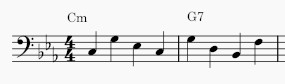
If you are wondering how to write a walking bass line, here are two common approaches using the chord progression:
Cm → G7
1. Using Only Chord Tones
The first note should generally be the root of the chord.
From there, build the line mainly using chord tones such as the:
- Root
- Third
- Fifth
- Seventh
Example using Cm → G7:
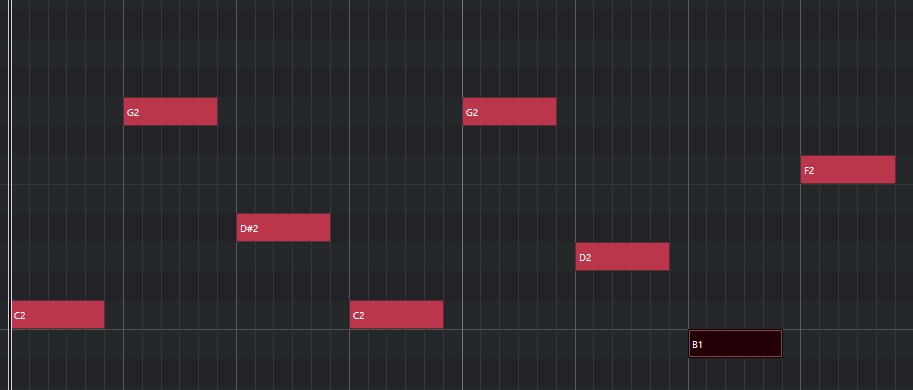
If you’d like to study it in your DAW,
you can also download the MIDI file.
2. Adding a Chromatic Approach Note
When moving from Cm to G7, it is common to approach the root of G7 from a semitone above or below.
For example, you can play F♯ or A♭ immediately before moving to G.
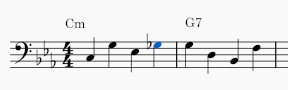
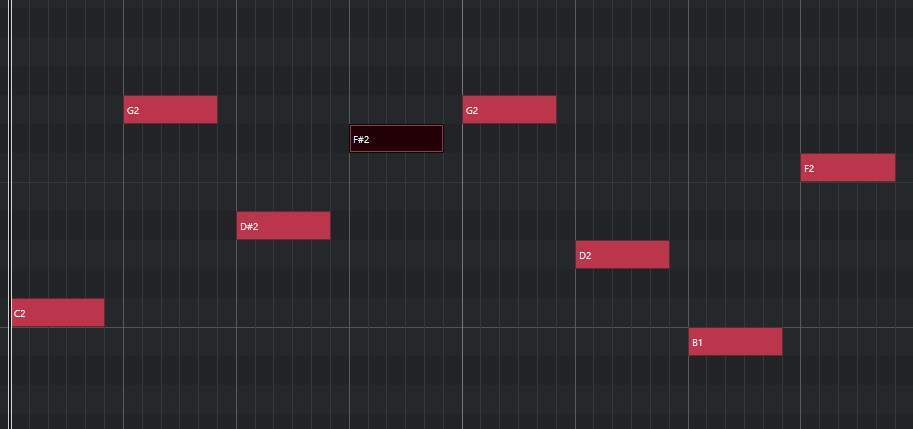
This type of chromatic approach instantly adds a stronger jazz character and makes the bass line sound more polished and professional.
EDM-Style Synth Bass Approaches
Because electro swing is also a form of club music, synth bass techniques are frequently used.
Synth bass sounds created with instruments such as Serum are a common choice.
1. Root-Based Synth Bass Pattern
This pattern is very simple, but it creates a strong EDM-style groove.
To make the arrangement sound more club-oriented, the following techniques are often used:
- Apply sidechain compression so the bass volume drops whenever the kick hits.
- Program the bass mainly on the offbeats so that it does not clash with the kick.
🎧 Full Mix Example
🎧 Bass Only
🎧 Bass Only — Offbeat Pattern
If you’d like to study it in your DAW,
you can also download the MIDI file.
Example

2. Donk Bass
Donk bass combines a hard attack with a short, bouncy low-end sound.
This bass style originally comes from UK hard house.
It gets its name from its distinctive “donk” attack sound.
In electro swing, donk bass works especially well in fast, club-oriented arrangements.
🎧 Full Mix Example
🎧 Bass Only
If you’d like to study it in your DAW,
you can also download the MIDI file.
Example
Hell the poppin’ – “Ambisicious”

3. Bass with Portamento
Portamento is an effect that allows one note to glide smoothly into the next.
It can be applied to synth bass sounds to create a distinctive sliding movement between notes.
This technique works especially well for:
- Aggressive bass lines
- Futuristic textures
- EDM-oriented arrangements
🎧 Full Mix Example
🎧 Bass Only
The bass sounds, MIDI files, and audio examples featured in this article are available to download.
Example
JACKMATE – “JACK BET”

Summary
Electro swing commonly uses both:
🎷 Jazz-inspired walking bass and root-and-fifth patterns
🔊 Club-oriented synth bass and donk bass
Knowing how to switch between these two approaches—or combine them—is one of the keys to creating a convincing electro swing groove.
Try incorporating these patterns into your own productions.
🎁 Free Bass Pattern MIDI Files
The MIDI files for the bass patterns introduced in this article are available as a free download exclusively for newsletter subscribers.
The newsletter also includes:
- Production techniques not shared on the blog
- Arrangement methods used in professional projects
- Updates about new articles and free production resources
If you want to expand your production toolkit, subscribe below and receive the free MIDI files.
👉 [Subscribe to the newsletter and receive the free downloads]

For Producers Who Feel Stuck Learning on Their Own
✔ “My tracks never sound as cool as I imagined.”
✔ “No matter what I try, it still doesn’t sound like electro swing.”
✔ “I feel like I’ve reached the limit of what I can learn on my own.”
If any of these sound familiar, I offer one-on-one online music production lessons.
Creating a convincing electro swing track involves several important techniques, including sound selection, rhythm, arrangement, and the use of effects.
Without understanding these techniques, it is only natural that endless trial and error may not bring you any closer to the sound you have in mind.
I experienced the same problem myself. When I was determined to learn everything on my own, I managed to complete only one track in four years.
Looking back now, even that track was nowhere near a level I would have felt comfortable sharing with other people.
After studying with a teacher, I learned the correct approach to arrangement and music production. I began to understand how to combine sounds, chords, rhythms, and other elements to create the sound I was aiming for.
Today, I’m able to analyze electro swing, write detailed production tutorials like this one, and produce music for artists and companies.
If you want to develop the knowledge needed to create the music you envision—and make tracks that captivate your listeners and fans—please take a look at the details of my online lessons.
My students include people from Japan, the United States, and Austria, ranging from complete beginners to those working toward a professional career.
[View the Online Music Production Lesson Details]

🎧 Want to Learn More About Electro Swing Production?
For a complete overview of electro swing production—including bass lines, chords, rhythm, arrangement, and sound selection—read the full guide below.
👉 The Complete Guide to Making Electro Swing
Bookmark this page so you can return to it whenever you are working on an electro swing track.